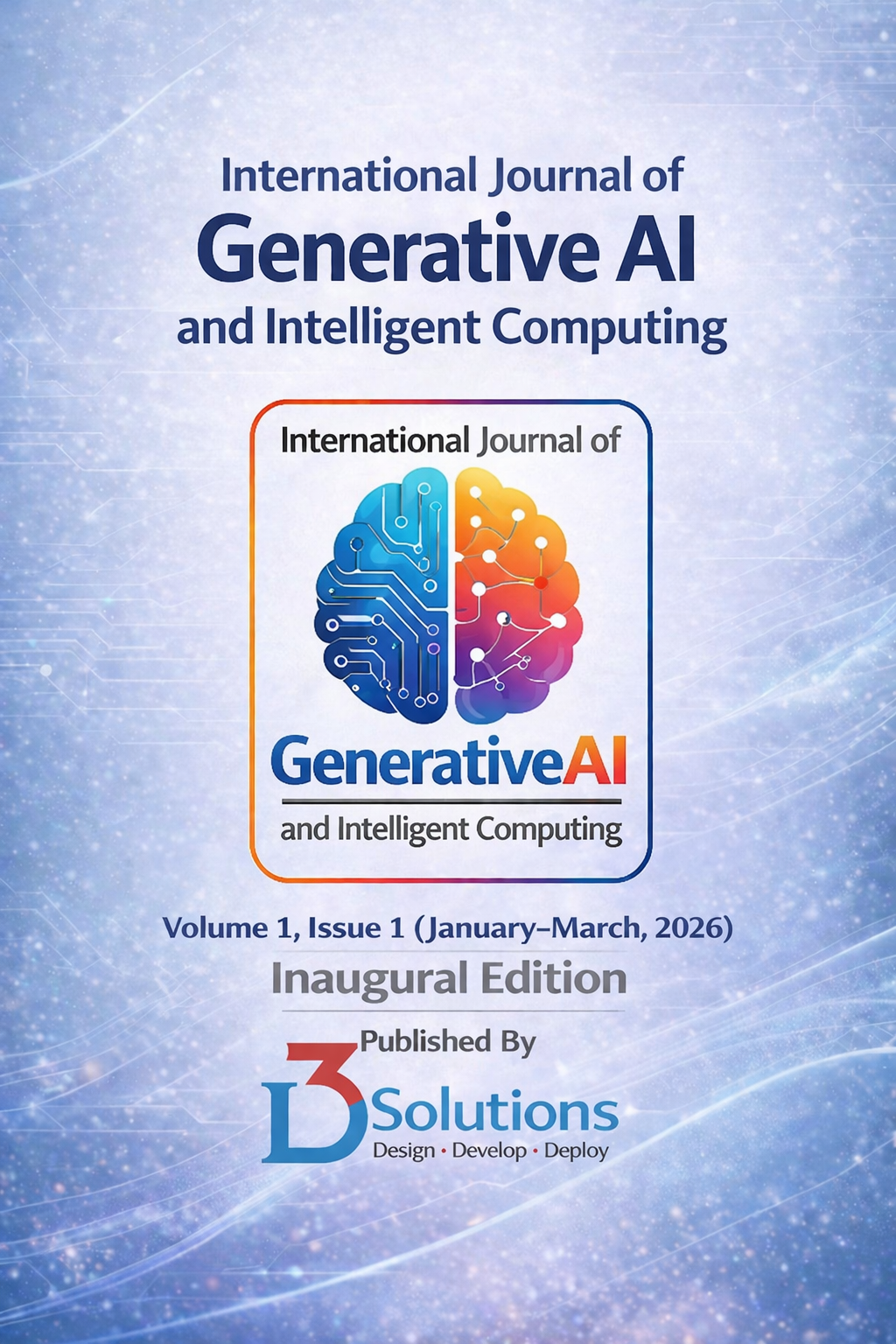
Publication Frequency: Quarterly (January, April, July, October)
Instructions Of Authors
About the Journal
The International Journal of Generative AI and Intelligent Computing is a peer-reviewed, national-level scholarly journal dedicated to publishing high-quality research across science, engineering, technology, and allied disciplines. The journal provides a platform for Indian researchers, academicians, industry professionals, and students to disseminate innovative ideas, experimental findings, case studies, and technological advancements that contribute to India’s academic and industrial development.
International Journal of Generative AI and Intelligent Computing Journal focuses on promoting original research conducted within India and encourages contributions that address real-world challenges, emerging trends, and practical applications relevant to the nation’s academic and industrial ecosystem. The journal follows a systematic editorial process to ensure quality, transparency, and academic integrity.
Publication Schedule
International Journal of Generative AI and Intelligent Computing follows a quarterly publication frequency, ensuring timely dissemination of research.
- Issue 1: January
- Issue 2: April
- Issue 3: July
- Issue 4: October
Accepted manuscripts are published online immediately after final acceptance to provide early access to the research community.
Manuscript Categories
Authors are invited to submit manuscripts under the following categories:
- Original Research Articles
Comprehensive studies presenting novel research results, methodologies, and findings. - Review Papers
Critical analyses of existing literature, emerging technologies, and current trends in relevant scientific disciplines. - Case Studies
Detailed evaluations of real-world applications, innovations, or system implementations.
Submission Process
- Manuscripts must be submitted electronically via the journal’s submission portal (available on the journal website).
- A cover letter must accompany each submission, stating the manuscript’s significance and confirming it is not under review elsewhere.
- Authors must disclose all potential conflicts of interest.
- Ensure that the manuscript strictly follows the journal’s formatting guidelines given below.
Ethical Considerations
International Journal of Generative AI and Intelligent Computing adheres to COPE guidelines and expects authors to maintain the highest ethical standards.
Plagiarism
- All manuscripts must be original and will be screened using plagiarism detection tools.
Data Integrity
- Authors are responsible for the accuracy of the data and must provide raw data if requested.
Human & Animal Rights
- Manuscripts involving human or animal subjects must include a statement confirming adherence to relevant ethical standards, institutional guidelines, and regulatory approvals.
Publication Ethics
- International Journal of Generative AI and Intelligent Computing follows strict ethical practices for authorship, data reporting, conflict disclosure, and citation accuracy.
Publication Fees
- International Journal of Generative AI and Intelligent Computing does not charge authors any submission or publication fees.
- It is a fully open-access journal supported by NOVARA PUBLISHERS.
Peer Review Policy
International Journal of Generative AI and Intelligent Computing employs a double-blind peer-review process to ensure impartial, rigorous evaluation of all submitted manuscripts.
- Authors and reviewers remain anonymous.
- Reviewers are assigned based on subject expertise.
- Final acceptance depends on revision quality and reviewer recommendations.
Submission Guidelines
General Structure & Formatting Requirements
|
Element |
Specification |
|
Font |
Times New Roman |
|
Font Sizes |
Title: 16 pt (Bold, Centered); Authors: 14 pt (Bold, Centered); Body: 12 pt; Abstract & References: 11 pt |
|
Line Spacing |
1.5 |
|
Margins |
1 inch on all sides |
|
Text Alignment |
Justified (except titles & headings) |
|
Layout |
Two-column format |
|
Page Numbers |
Bottom-right corner |
Required Manuscript Sections
- Title of the Paper
16 pt, Bold, Times New Roman, Centered - Author Name(s)
14 pt, Bold, Times New Roman, Centered - Affiliation
Department, Institution, City, Country
12 pt, Times New Roman, Centered - Email address
(12 pt, centered) - Abstract
Provide a concise summary of the research problem, methods, results, and conclusions. (11 pt) - Keywords
List 5–7 relevant keywords that reflect the core content.
Main Body Sections
- Introduction
- Background, problem statement, motivation, objectives
- Literature gap identification
- Literature Review
- Summary of existing research
- Gap analysis related to the proposed work
- Methodology
- Materials, methods, models, algorithms
- Experimental setup, tools, or datasets
- Results and Discussion
- Analysis of findings using figures, tables, and graphs
- Comparison with prior studies
- Conclusion and Future Work
- Summary of contributions
- Limitations
- Recommendations for future research
References
- Use IEEE or APA referencing style (as preferred by the author).
- Ensure consistency between in-text citations and reference list.
Declarations (Optional)
Authors may include statements confirming:
- Originality of the manuscript
- No prior publication
- Not under consideration elsewhere
- Conflict of interest declaration
Publication Metadata
At the end of the manuscript, include:
- Submitted: DD/MM/YYYY
- Accepted: DD/MM/YYYY
- Published: DD/MM/YYYY